Saturday, November 16, 2013

Painting my latest 40k model

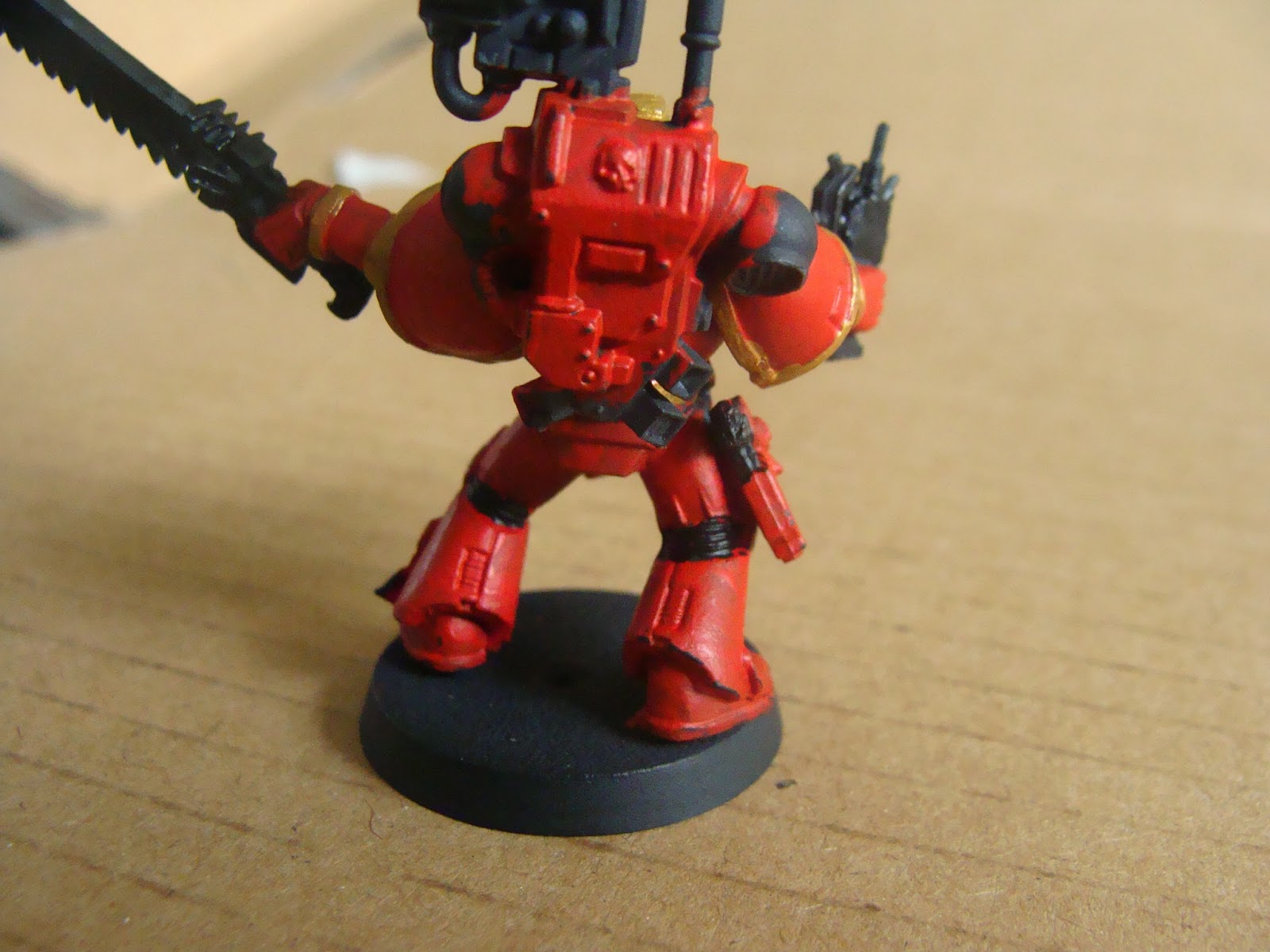
I decided to take some pictures and describe the steps I take when painting 40k miniatures. I am painting a Blood Angel Devastator Squad Sergeant. I didn't get pics of the assembly, or the priming.

Step 1, Priming - I used a black spray paint over the entire model. I use a flat black as a base coat on my entire army. I want my army to have a dirtier, war-torn look. I don't want them to look spiffy and brand new and not battle tested, like a brand new space marine straight out of space marine boot camp. While a big portion of that look is achieved by applying a wash later, it starts with the black base coat.


Step 2, Painting the Majority Color - I used a citadel paints layer. The color is "evil sunz scarlett". The reason I use a layer is so it doesn't completely cover up the black base coat, allowing some of the black to show through and give it that dirty look I am going for.

   I apply the paint pretty generously, giving two to three layers until I have the right amount of base coat showing through. At this stage, I don't worry about splashing paint onto other parts of the model, as I will be covering those parts up with a different color later.

   While I am using my red, I go ahead and paint his eye and breather. The helmet will end up being a gold metallic, but I get the low points now so it makes detailing easier later.


Step 3, The Helmet - The helmet of my units is something I like to diversify a little bit. My leaders normally have a 'custom' helmet, while my rank and file soldiers have the usual red helmet. For my devastator squad, I decided on going with a silver helmet and silver trim instead of black trim, since they are an elite squad (and have performed VERY well in play testing). For my leader, I decided to go with gold instead of silver to set him apart from the rest of the squad.

   Using a metallic acrylic gold in the FolkArt line, and a detailing brush, I apply a layer of paint over the entire helmet, outlining the eye and breather. Because this brand of paint is thinner, it takes several layers to cover it properly. Also, it doesn't dry as quickly as citadel paints, so this step takes a while between layers.

   I splashed a little gold into the eye socket on my second layer. So I had to go back with the detail brush and a drop of red to fix it. And since it was a recessed spot, I had to go back over the outline with gold.

   I used a citadel color, "abaddon black", for the antenna and hoses on the helmet. This color is a base, so it covered up any splashes easily.


Step 4, Trim - Using the same color as the helmet, I outlined all the areas that would normally be trimmed in black, like the outline of the shoulder pads, elbow pads, etc. This part takes a while due to the constant back and forth of colors. Anytime, I make a minor mistake, I have to switch colors to correct it.
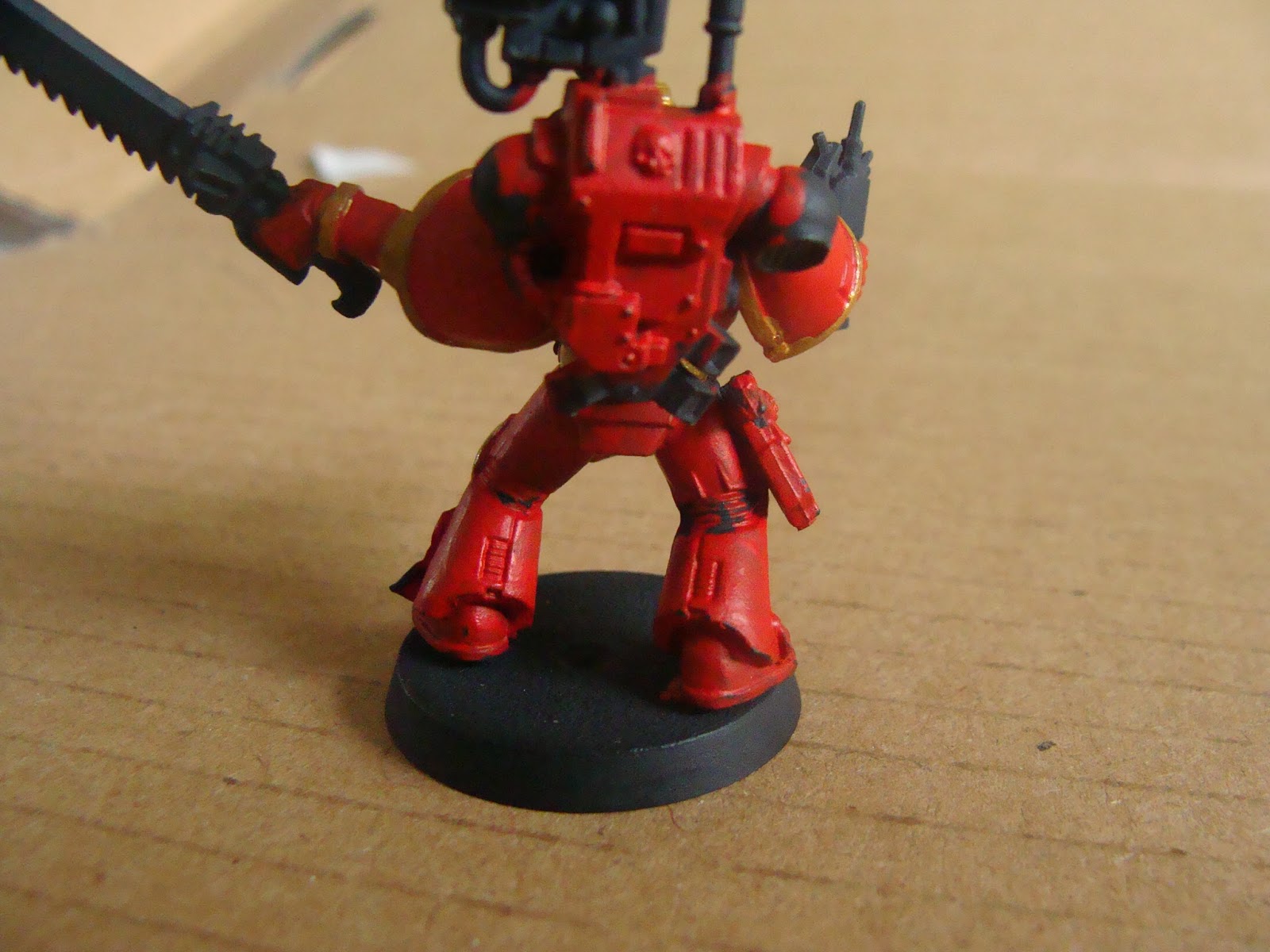

   Normally, I don't color the knee pads, but to break up the monotony I decided to paint them the same gold color.

   It was at this point that I realized why I thought the gold and the red looked so good together, and why it looked like something was missing when the knees were still red. Look at the picture. Look closer. Got it yet? If not, look again. ... ... ... IRONMAN!!!!!

   At this point I'm hoping that the coloring of some of the details, especially with the purple and white coming up that it will no longer look like Ironman when it's finished. Part of me wants to continue with the similarities for fun, but I need to keep in with the theme of my army. (Who am I kidding?! I am eventually going to have a darth vader model be my commander!) So I decided to keep going with my normal paint scheme instead of going crazy with it.


Step 5, Joints, Hoses, and other things that need to be black - This step is all about putting black paint into recessed areas, like the back of the legs, under arms, and then re-blacking any parts that got splashes on them. Normally this goes in with the trim, since I usually trim in black. But since I did gold for trim, I obviously had to split the steps. (Can't paint two colors at one time.) Once the black is in the recesses, I take red and outline the splashes to keep the black contained. This also serves to give another layer and add some depth to the red.


   I also went back in this step and colored the belt buckle gold, as I failed to hit it last step.


Step 6, Weapons - Unlike the armor, which shows signs of wear, I like the weapons to maintain a crisp appearance. Any soldier worth his salt is always cleaning his weapons, keeping them in tip top shape for battle. I black them nice and crisp, and then add some little details, such as silver blades for the chainsword using citadel paints "ironbreaker".

   I also decided to paint a screen on the signum, adding just another little touch of realism. I used a paint that I don't know, as it was given to me by someone else. It's kind of a diminished neon green. I wanted to mimic the green screens of some of the old military equipment of the US Army.

   I then decided to use a black metallic acrylic from FolkArt on the chainsword and bolt pistol, just to add some more snap.


Step 7, Chest emblem - I paint the imperium emblem with a white skull, (Citadel "ceramic white"), silver outline, and layered wings of red and purple (Citadel "xereus purple"). Always start with the most recessed areas first, or you'll have to go back and do them anyway. While I have my purple out, I go ahead and use the purple on the wax seals of the marks of honor. Then I'll use Citadel's "screaming skull" to give the marks a parchment look, and then finish up with small lines of black so mimic writing.
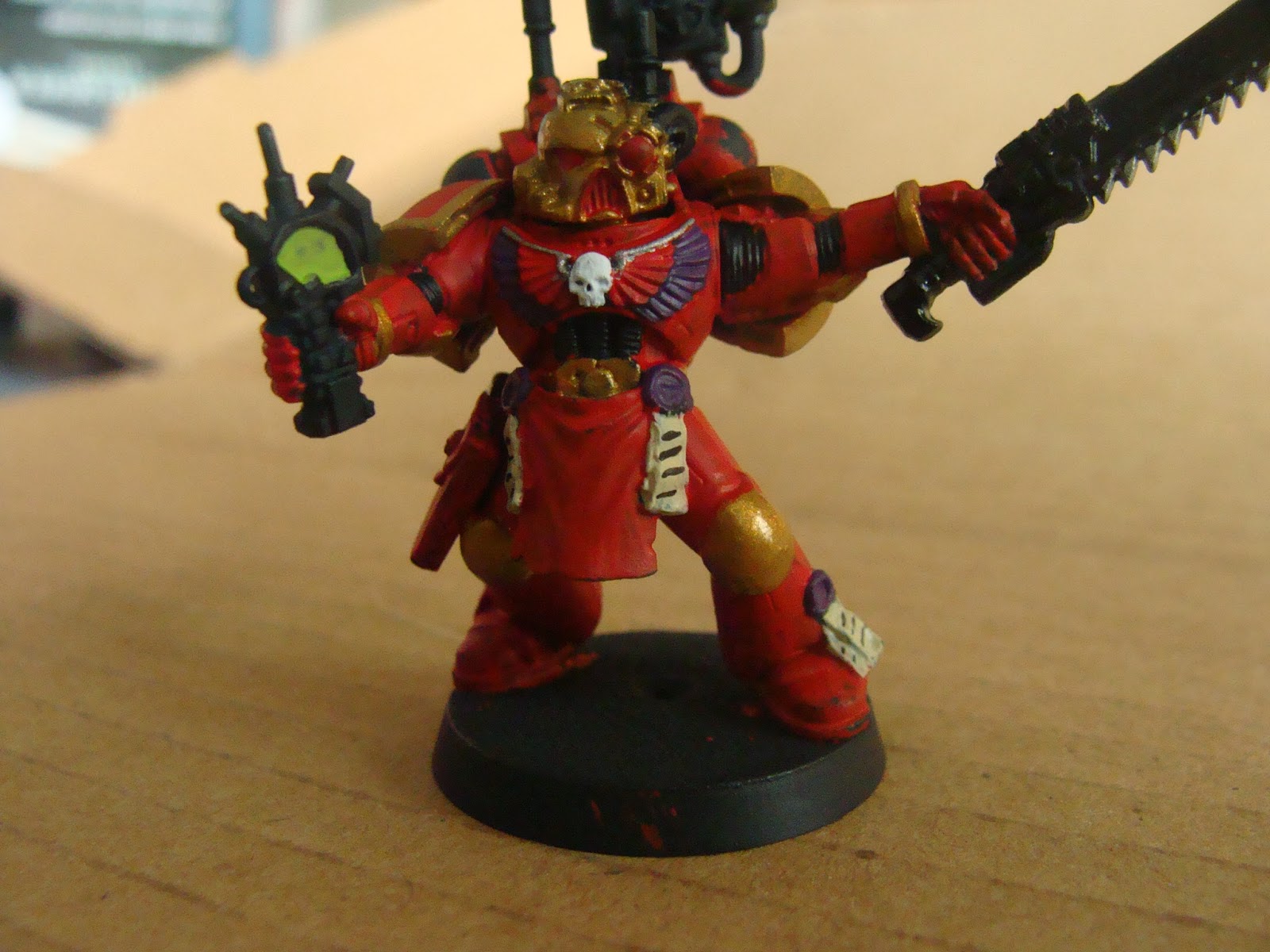
 

Step 8, The Backpack - I use a similar pattern on the backpack that I use for the emblem. It's pretty straight forward, start with the recesses again, and then work your way out.


Step 9, Rangefinder - I decided that the rangefinder on top of the backpack should be treated like a weapon. So I put some black metallic on it, and then touched up the antenna, and put some minor details on the rangefinder.


Step 10, Banner - Here's where things get bad for me. I can't freehand that well. I put a silver border around the banner, and made the frame it was hanging on red. I then tried freehanding a skull on it, but it sucked. So I put red "D" on it for the devastator squad overlaid with an "A" for Alpha Company. I painted the emblem on top like the chest emblem. In this step, I added an "AD" on his left shoulder, for "Alpha Company, Devastator", and an E7 rank on his right shoulder.


Step 11, Dirtying it up - For the last step, we take Citadel "dryad bark" brown, and water it down quite a bit. Then we paint several layers over the whole model, allowing it to dry in between layers. This gives the whole model a dirty, war-torn look. It also highlights the low areas, bringing in some shading. Watering down the paint allows it to wash off of the raised areas, and collect in the low areas, meaning they'll be darker; just like how in real life dirt will collect in cracks more than all over.


So there you have it. The whole process took me about four hours. I'm getting better at painting. Not at good as I'd like to be, but way better than where I was. My goal is to eventually be able to paint and get paid for it. Long way off, I know, but I'm getting there.

 - Sapper Woody

Friday, October 18, 2013

Our World, The Matrix

   Years ago I read a book entitled "Arena" by Karen Hancock. It was an excellent read, and I've read it two more times since. The book is an allegory of our universe, using advanced aliens in lieu of angels, a handbook in place of the Bible, and a virtual guide instead of Jesus. The story is compelling, where two friends take part in a test which transports them to an alternate reality in which they must follow this handbook and stay on a path to get out of the test. Along the way they get sidetracked and end up spending a long time in this simulation.
   The thing is, I've used this book as an explanation to people before about how the world works. I've told them that the universe is basically a contest to bring glory to God. That Satan and God are vying for souls in order to increase their own glory, with God of course coming out triumphant in the end.
   Consider the story of Job. Job was living his life in prosperity, when Satan went before God and basically said that Job was only serving God because God was blessing Job. God says, "We'll see about that" and let's Satan begin messing with Job's life, first taking his possessions, then his children, then his health. Job's wife even told him, "Curse God and die." But Job never turned on God, and in the end got more than he started with.
   Also, consider the words of the apostle Paul in Ephesians 3:8-12 (KJV):
"Unto me, who am less than the least of all saints, is this grace given, that I should preach among the Gentiles the unsearchable riches of Christ;
"And to make all men see what is the fellowship of the mystery, which from the beginning of the world hath been hid in God, who created all things by Jesus Christ:
"To the intent that now unto the principalities and powers in heavenly places might be known by the church the manifold wisdom of God,
"According to the eternal purpose which he purposed in Christ Jesus our Lord:
"In whom we have boldness and confidence by the faith of him."
   This passage has intrigued me for a long time, especially after reading that book. If we look closely, we could easily interpret that passage to mean that there is a contest is heaven in which God is "proving" (for lack of a better word) himself to Satan and the angels. Especially in verse 10:
"To the intent that now unto the principalities and powers in heavenly places might be known by the church the manifold wisdom of God,"
   Sounds to me that he is showing the principalities and powers in heavenly places His wisdom, using the church as a vessel to do so.
   With all this being said, I was looking at some string theory and M-theory for fun and came across some recent articles about how scientist are now wondering whether or not we are living our lives in an advanced computer simulation created by an intelligent being/beings that are using the simulation to make a better future for themselves.
   Some have even theorized that this is fact, and have begun to studying our universe in this light.
   As a believer, while I don't believe that God is part of an intelligent race running a simulation, I think this is a good explanation of what is going on. Is God really a kid playing an advanced game of The Sims? No. But the similarities are eerie. I think that the similarities are a good way of explaining things to people with questions. Whatever you believe about this (as a Christian, unless you believe we are just part of a computer program), the good thing is that it doesn't change the ultimate question which is, "Where are you going to spend eternity?" But it can answer some difficult questions such as, "If you believe the Earth is young, why does it appear to be billions of years old?"
  For some more interesting reading, I suggest the book "Arena" by Karen Hancock. I also have a couple of links to some websites discussing the matter:

http://www.ign.com/articles/2012/12/14/scientists-ask-are-we-all-part-of-the-matrix

http://www.messagetoeagle.com/bonnsimulationvirtworld.php

http://hackingchristianity.net/2013/09/are-we-in-the-matrix-are-angels-testing-us.html

   Let me know what you think.

- Sapper Woody

Saturday, November 10, 2012

DPS or Survivability?

   A huge debate is going on right now in Diablo 3. The “end all” stat it seems right now is DPS. You will find people looking for someone with a certain DPS in order to run higher monster powers. Many people boast about how their DPS is over 100k, or even higher. Some Demon Hunters can get their DPS to over 250k if they are out of combat long enough, due to a passive.

            Now, this DPS number is often inflated, as in the case of Demon Hunters, as soon as they get into combat and hit their first enemy, their critical chance drops from 100% to their regular levels. They have a passive ability that every second that they don’t get a critical hit, their critical hit chance goes up. So, as long as they are standing around, it looks better than it actually is. But this is not the point of my post.

            This post is going to take a look into the formula behind survivability and DPS, and decide which is better. If you can deal 100k DPS, but die in 2 seconds, you’re not doing very well. Conversely, you may be able to withstand any kind of damage, but if you can’t kill elites or bosses before their enrage timers go off, you are useless.

            So, it’s kind of obvious to me (and hopefully to you, too) that a balance has to be maintained. But how do we determine which we need? Do we need more all resist, or critical hit chance? Do we need more armor, or critical damage?

            By taking the formula that is used to decide certain things, and then comparing the results, we can see what will be best in our current situations. First off, here are some formula used by the game:

Damage Reduction From Armor = Armor/(50*Enemy Level+Armor)
Damage Resist = Resist/(5*Enemy Level+Resist)

As you can see, the armor and resist scale parallel, with 1 resist being worth 10 armor.


As the chart to the left shows, armor (and resistances) has huge diminishing returns. The chart assumes a level 63 enemy.


The first 500 armor (50 resist) give 13.7% damage reduction. The second 500 (50) gives only 10.4% damage reduction. At 9500 armor (950 resist) the next 500 (50) only gives .95% damage reduction.


Now, don’t get me wrong, stacking armor is never a bad idea. But, stacking it to the exclusion of a stat that might help you out more is a bad idea.


   The point here is that there is a point where it is pretty much useless to stack more armor. Diablo 3 doesn’t have an armor cap, but with diminishing returns, it would take 25,000,000 armor to equal a 99.99% resistance. Technically speaking, you could never reach 100%, since as one value grows, you are dividing it by another value that grows in proportion. Eventually, you’d round up to 100%, but you’d never truly be there.

   Now, we have DPS. To determine overall DPS as shown on your character sheet, you use the acronym SCRAM. In this example, we’ll use my Barbarian’s numbers (unbuffed).

S = Your damage attribute * .01 + 1    In my case, S = 1996 * .01 + 1 = 20.96

C = Crit Chance * Crit Damage + 1     In my case, C = .2 (20% crit chance) * 1 (100% crit damage) + 1 = 1.2

R = Attacks per second, including any attack speed modifiers.  For me, R = 1.1

A = Average Damage. (Min DMG + Max DMG)/2    For me, A = (1021 + 1515) / 2 = 1268

M = Any damage multipliers from skills, plus 1. I have none, so I am just at 1.

Then, you multiply each value together. My Barbarian:

20.96 * 1.2 * 1.1 *1268 * 1 = 35082 DPS

   So now we know how to find resistances and DPS. But, how do we decide which is better for us? Well, this involves a comparison of current stats to possible future stats. I can’t sit here and say something like “1 armor is equal to 3 DPS” or anything like that, because for you, 1 armor might be worth 17 DPS, or vice versa. If you are stacked on armor, your armor has a lesser value than someone who isn’t.

   So, to figure out which is best for us, we need a common denominator; something to bring these equations together and give them a common ground to compare them, so that we can compare apples to apples instead of apples to oranges. In Diablo 3, and also in many RPG games, this number is the amount of damage that will be dealt to you by a monster throughout the course of a fight.

    There is a long formula to find this number, but we will break it down. But I want to impress you with my formula, so I am going to write it in it’s entirety here:

Enemy DPS * (1 – (armor / (50 * enemy level + armor)) * (1 – (average resist / (5 * enemy level + average resist)) * (Enemy Health / ((Damage Attribute * .01 +1) * (Crit Chance * Crit Damage +1) * Attacks per Second * ((Minimum Damage + Maximum Damage)/2) * Damage Multipliers)) = Total damage done to you

    Basically, this formula is saying that we take the enemy’s DPS adjust it for your resistances, and then multiply it by the amount of time it will be alive. For myself, I have made a spreadsheet that I can put the raw values in, and it will give me a baseline total damage done to me. Then I can tweak the numbers, and change some resistances, and then compare the new results. Then I can tweak other numbers, and compare the results to the previous results, allowing me to decide if I need more resists or more DPS. Here is a screenshot of my current values, in which I used the information of a Dark Thrall from Inferno difficulty. I filled in the yellow areas, and the blue areas auto populated.

The “NET DMG to You:” number is the number we want to reduce. Pretty much, increasing any attribute will reduce this number. As you can see, I inserted the “NET DMG to You” number in the “Base NET DMG” box. Next, I decided to see what happened when I changed my armor to 5,000. And this is the result:
As you can see, the “NET DMG to You” went down to 4687.54. I inserted this number into the “Change with RES”, and the “% Gain” box populated to show a 6.63% increase in efficiency. So, for me, 534 armor would give me 6.63% more efficiency.

Now, I am going to put my armor back where it was, and compare it to a 5% increase in Critical Hit chance. And this is the result:
As you can see here, 5% more critical hit chance brings my “NET DMG to You” down to 4819.76. I plug that in to “Change with DPS”, and the “% Gain” auto populates to a 4% increase of efficiency. So, when you compare the two, you see that 534 armor is worth more to me in my current state than is 5% critical hit chance.

   One thing my spreadsheet is not programmed to do is to take into account the fact that strength also adds to armor. I also have not taken into account that Dexterity adds to dodge chance. So, if you change those numbers, you might have to account for the armor and dodge chances manually.

   So, as you can see, sometimes DPS is not the end all stat. Sometimes, in order to deal more damage, you have to be able to take more damage.

 I wasn't able to embed the spreadsheet in this post, but if someone wants it, just zip me an email at sapperwoody@live.com and I can email it to you.

            - Sapper Woody

Friday, June 15, 2012

Beating a Game


            “I beat the game!” This is an oft heard thing around gamers. “Have you played <insert latest game>?” “Yeah, I beat it three days ago.” Typically, “I beat the game” means “I completed the story.” But, what does it really mean to “beat the game”? Let’s take a look at a few of the meanings of “I beat the game.”
            First, as we said before, many people have come to the conclusion that completing the storyline in a game is beating the game. For these people, it’s more about getting the end rather than the journey itself. But that is how a majority of gamers play. For many, it’s no longer about how amazing the journey is. Rather, it’s how many notches they have on their gamer belt. If this is what you prefer, then by all means play that way. After all, it’s all about doing what you enjoy. However, can one really make the claim that they beat a game if they played it on casual/easy mode? Doesn’t there need to be a certain challenge in order to beat something? If I were to say, “I beat this bottle of water. I drank the whole thing over the course of a day”, people would look at me like I was stupid. If there’s no challenge, then there’s no victory.
            This brings us to another question. What about cheat codes? “I couldn’t beat this part, so I turned on invincibility so I could beat it.” Did you really beat it? In my opinion, using cheat codes is not beating the game. In fact, in my opinion, it is just the opposite; it is admitting defeat to the game. In essence, you are saying, “The game was too hard. I gave up and cheated.” So, if you used cheat codes at any time, you did not beat the game.
            Another meaning of “I beat the game” is “I played through the story on the hardest difficulty setting.” I am almost completely in this camp. For a long time, I was one of those players who played games on the default setting. After all, isn’t that what the game was tuned to? However, just recently, my roommate got me to try any and all games on the hardest difficulty. I am now addicted (I use this term loosely. See the last section) to playing all games on the hardest setting. When I complete a playthrough, I feel a sense of accomplishment again. It’s not just another notch in the gamer belt. It’s a victory. It is a moment to savor. It is a moment when you are standing on the proverbial mountaintop screaming (again, proverbially) “I did it! They threw everything they could at me and yet I accomplished the improbable task against impossible odds in the face of unlikely adversarial conditions!”
            For some, playing on anything harder than the default setting is too much work. Others see it as an addition to playing on the default difficulty to add more replay value. For me, it’s the meat and potatoes of the game. It especially makes me feel great when I beat a game on the hardest whose hardest setting is legen…wait for it…dary!
            Still, for others, “I beat the game” means that they got the highest award in every level. Take my recent post about Twisted Metal, for instance. A friend and I beat it on Hard difficulty. Not good enough for me. I had to beat it on Twisted difficulty. Once we were done with that, we realized that we had gotten Gold in every level except 3. So we felt compelled to get gold in every level. To some, this is beating the game. Achieving the highest standard in each level. Any part of me that is not in the last camp is in this camp. While I don’t feel compelled to beat every level at the highest standard, sometimes I do just for the extra sense of accomplishment.
            Others considered it beating the game if you complete all the achievements. After all, the developer made the game, and decided what achievements to include. So, if you get all the achievements, then you’ve done everything the developers want you to do, right? The neat thing about this thinking is that it includes all of the aforementioned ideas concerning beating the game. About half, if not more, of the achievements in video games are pretty much standard now. Beat a level? Get an achievement. Beat the same level on the hardest difficulty? Get another achievement. Beat the level at the highest standard? Get another achievement.
            Whether you think that getting all the achievements is necessary to truly beat a game or not, no one can argue with the fact that the person with all the achievement did beat the game. He accomplished everything in every camp, plus went back to do little odd jobs to get more. Too much for me, but kudos to the guy who does it.
            Another thing that comes to mind when someone says, “I beat the game” is, “Wow, you beat Triple H?” For those of you who are completely lost right now, that was funny. Triple H is a WWE wrestler, who at one point went by the handle “The Game”. So, when someone says, “I beat the game”…. Ok, hopefully you get it now.
            Lastly, I’ve heard someone say “I beat the game”, and mean that they got over their addiction to video gaming. (World of Warcraft specifically.) Video game addiction isn’t as common as some people would have you believe, but is more common than most people realize. If you are struggling with video game addiction, call somebody. I don’t know who to call, as I don’t think that there is a video game addiction hotline. (I just googled “Video Game Addiction Hotline”. The only things that came up were parodies of addiction hotlines. So, if you’re addicted, you’re out of luck. Cold Turkey, anyone?)
            So, whatever your definition of beating the game is, it really doesn’t matter what others think. As long as you are having fun, that’s what counts. So get out there and play games!

   - Woody

Saturday, June 9, 2012

Twisted Metal (PS3) Review


          Back when I was younger, I remember playing Twisted Metal on Sony’s original Playstation. I was enthralled by the death match modes while driving cars. At that time, it was an original concept and not very well emulated by anyone. So, following my current trend of playing remakes and re-releases, I allowed myself to be suckered into playing Twisted Metal as released on the PS3.

          The first thing that needs to be said about this game is that it is not an old release that’s simply been rendered with better graphics. This is a whole new game that pulls from its old roots over ten years ago, and did a complete makeover of the series. If you’ve played the newest Mortal Kombat, you know what I’m talking about. Both games have taken the old story, and updated it, and released a whole new game.

          One of the things that I loved about this game is the offline 2-player co-op gameplay. You can play through the entire campaign by yourself or with a friend. Myself, I come from the school of thought that says that anytime I can play with a friend, it’s preferable to playing by myself. So, me and a buddy grabbed a borrowed PS3 and borrowed the game and started to play.

          My buddy isn’t really a hardcore gamer. But he is your average gamer when it comes to ability. He won’t drag you down in co-op gameplay, but he’s not on the first round of picks for online competitive multiplayer in games. So, we decided to skip the easiest difficulty and play it on the second difficulty, hard. We played for a few hours one night, and then finished it the next morning. Once we had beaten it on hard, we decided to try the “Twisted” difficulty. It took us several hours to beat that difficulty, but when we were done we realized that we had gotten a gold rating on all the maps except three. So we went back and got gold on all maps on the Twisted difficulty.

          The campaign overarching story follows a character named Calypso. Calypso hosts a tournament (again, think Mortal Kombat) where there are different events to play, each one driving a vehicle, and each one ending with you killing off all your opponents. The winner of the tournament gets a single wish granted. Fans of the old series will remember that once the wish is granted, it is in some twisted way that ends up killing the person that made the wish.

          The campaign is split into three sections, each consisting of five events plus a boss event. All three sections happen at the same time chronologically, but you have to complete one person’s story before advancing to the next story. You start off playing as Sweet Tooth, the demonic clown that has become the series’ banner. After completing his story, you become a man with a honorable goal of going back in time to save his father from death. Then, you become a sadistic, insane runway model who has aspirations of being the top model in the world.

          Even though you can not choose your driver in the campaign, you still have the ability to choose the car that you drive. Each car has strengths and weaknesses. Some posses more armor, and are capable of dealing damage by ramming into other cars, but at the expense of speed. Some are quicker, with lighter armor. Others are geared more towards their special weapon’s ability. Probably one of the most unique vehicles to play as is “Talon”, a helicopter who can use a magnet to grab cars, fly high, and then drop them.

          Even though the campaign only consists of 18 matches, don’t expect it to be over quickly. If you actually beat a match, it will take only about 3-5 minutes on average. But don’t expect to beat every match on the first try, especially on the hardest difficulty, and also especially the boss rounds.

          All the rounds in the campaign are not deathmatches either. The deathmatch is a staple of the game, but there are several variations. There is a “cage match” mode in which you must stay in a cage, or lose cumulative time on your grace period. If your grace period runs out, you start taking damage. Your goal is similar to deathmatch; kill your opponents before you die.

          There are a couple races in the game, too. In these levels, every car has a bomb attached to it. Once the first place crosses the finish line, the rest of the cars’ bombs are triggered, killing the other drivers. As you are racing, you may also kill off other drivers with your usual weapons.

          Another mode worthy of noting is the juggernaut modes. There are a few variations, but they basically boil down to one thing. You have a few enemies, and one semi with a trailer called the Juggernaut. The Juggernaut has more health and armor than any other vehicle in the game. Your goal is to kill all the enemies before dying. The unique thing is that every 90 seconds or so, the Juggernaut will spawn another enemy. So, you need to kill the Juggernaut to keep him from spawning more and more enemies.

          After each match, you will be given a ranking based upon the speed in which you beat the match. There are four rankings; gold, silver, bronze, and no award. As an extra challenge there is an achievement for getting all golds, and another for getting all golds on Twisted difficulty.

          The graphics and sound in the game are not breathtaking, but there are more than sufficient. This game isn’t about a beautiful world; it’s about carnage. It’s about killing off other drivers in order to win your place at the top. With that being said, this isn’t a game for kids. There is gore and language throughout the game.

          All in all, it was a fun diversion for a few days. But now that I’ve beaten the hardest difficulty with all gold, there’s not much more to do since I can’t go online out here in Afghanistan.

   - Woody

Sunday, June 3, 2012

Halo: Combat Evolved Anniversary Review


            Throughout gaming history, there have been several games that have defined the future of gaming. In my opinion, gaming as we know it today started all the way back with Jump Man, who became the character we came to know as Super Mario. Moving forward in time, we come to Zelda, the first game to allow you to save your progress. Games tried to become First Person in the 70s with games like Maze Wars and Spasim. MIDI Maze featured PacMan style gameplay in first person in 1987, and was unique in that it allowed for multiplayer over a MIDI interface. In 1992 Wolfenstein 3D was introduced, and a whole new era of gaming began. Shortly thereafter in 1993, Doom came out, furthering the genre with the ability to play multiplayer. Then, in 1996 Quake hit the market. Finally a game that featured 3D modeling instead of 2D models in a 3D world. That same year, the wildly popular Duke Nukem also came out.

            In 1997, 007: Goldeneye was released for the Nintendo 64. For many people, especially console gamers, this was their first experience with a FPS. The ability to play deathmatches in 4-player split screen was amazing. The next year saw a couple of games released that built upon the FPS idea and took it farther in leaps and bounds. Unreal, whose engine is still used today to design games; and Half-Life, which remained popular well into the next century. In 2000, Perfect Dark was released as the spiritual successor to Goldeneye. I experienced my first co-op campaign in Perfect Dark, and was amazed at the split screen.

            Finally, in 2001, combat evolved. Halo was released for Microsoft’s XBOX, quickly becoming the flagship of the console. Featuring huge levels, an immersive storyline, cut scenes that were unrivaled, and intense gameplay, Halo became a favorite for LAN parties. I remember hooking up several consoles and playing multiplayer deathmatches with friends.

            The Halo universe took off. Originally designed as a RTS, Halo featured a futuristic war in which the covenant (a group of several different types of aliens from different planets brought together by religion) sought to enslave or destroy humanity, who was an affront to their gods. Halo 2, Halo 3, Halo ODST, Halo Reach, and Halo Wars all came about from the original success of Halo: Combat Evolved.

            Move forward in time 10 years, and we have the remastered re-release of Halo: Combat Evolved. Released as Halo: Combat Evolved Anniversary, this game is everything that I had hoped for when I played the re-release of 007: Goldeneye. The gameplay is amazingly the same as you charge around killing the Covenant (and eventually the Flood) feeling like you could take on the world with your recharging shields.

            This game brought a whole lot more to the table than just updated graphics, however. Halo: Combat Evolved Anniversary incorporates the bonus skulls which have become popular in the Halo series. It also brought the Firefight mode, in which you fight to survive waves of enemies. It updated its multiplayer experience to be on par with other Halo games, allowing for a lot more customization of your avatar and for unlockables. Forge mode has been included as well.

            The game also features a unique ability. By hitting the “back” button (still called “select” by a LOT of people, even though it’s always been “back” on Microsoft consoles) you can have the graphics revert back to what they were 10 years ago. I played with this feature extensively. It was amazing to see the advances made to the game. Grass where there was just a carpet of green, leaves on trees, high resolution textures where there was just matte finish, and updated character skins are all amazing when seen in contrast.

            A little disappointing to me was the voice synchronization. I understand that they used the same track and just updated the graphics, but the timing was still as bad as the original. 10 years ago it was great, but with the advances made today, you think they would have tweaked that. Or, it’s possible that they left that there as a throwback. It really appears as if they updated the graphics, retexturing everything, and left the game as is. This is amazing yet slightly disappointing at the same time.

            Even though Halo: Combat Evolved was the first Halo game released, it is not the first part of the story. To get the full story chronologically you have to play the RTS Halo Wars, set in 2531, or 21 years prior to the events of Halo: Combat Evolved. Next you have to play Halo: Reach, which takes place immediately prior to Halo: Combat Evolved and leads directly into the story.

            Then comes Halo 2 and Halo 3. If you want a little side story, you can play Halo: ODST which technically takes place between Halo 2 and Halo 3, but doesn’t deal with the main story. Instead, you become an elite human soldier called an “Orbital Drop Shock Trooper” (hence the letters ODST) as you explore the city of New Mombasa trying to discover what happened to your teammates.

            Halo: Combat Evolved Anniversary follows the story of the original. It begins with the ship “The Pillar of Autumn” just having made a jump through space. We find out in future games that they had just jumped from a planet called Reach, a massive naval base, where the covenant had just wiped everyone out. In this jump, the covenant was able to follow them, and end up boarding the ship. With the destruction of Reach, there is only one Spartan left. Enter Master Chief Petty Officer John – 117, known affectionately simply as Master Chief.

            Coming out of the jump, the Pillar of Autumn is close to a massive ring known only as a Halo, where the series gets its title. In the first level, you are tasked with the care of Cortana, an AI that gets implanted into your helmet. You fight your way through the ship to the escape pods, where you escape to the surface of Halo. Once there, you try and find out the secret of this huge ring, and end up discovering that it is a huge weapon of some kind. This starts a race against the covenant. The Covenant inadvertently releases the Flood, aliens who inhabit the bodies of others. You find out that Halo is a weapon designed to wipe out all sentient life in the galaxy, and thus stop the spread of the Flood. You end up destroying Halo, and in a memorable last level are outrunning explosions in a Warthog, and amazing dune buggy type vehicle.

            Playing this game was a fun blast back into the past. With the updated graphics, it also allows you to play the games in chronological order without feeling like you are taking a step back in time. Even though I had beaten Halo: Combat Evolved, I had to beat Halo: Combat Evolved Anniversary because Bungie included achievements this time around.

            Playing this game made me look forward to the release of Halo 4-6, the “Reclaiming Trilogy” which promises to be even more of the action game that we all love, and finish out the story.

   - Sapper Woody

Sunday, May 6, 2012

Prototype 2 in Review

   I picked up Prototype 2 on the recommendation of a friend, having never played Prototype 1 before. One of my main concerns with picking up a sequel without having first played the original is coming into a story without knowing the background of what is going on. Fortunately, in Prototype 2, there is a video that will give a synopsis of the first game, and it brought me up to speed.

   Prototype 2 takes cues from a host of other games. Basically, there was a viral outbreak that infected a whole city. Most people that get infected generally become zombie-like in nature, although some exhibit super-human abilities.

   The virus has been developed by Gentek, in conjunction with the paramilitary group Blackwatch. In the story leading up to Prototype 2, Alex Mercer has been blamed for the release of the virus. In the second game, you play as Sergeant James Heller, a soldier who blames Mercer for the loss of his wife and daughter to the virus. In the opening sequences, you confront Mercer only to be infected yourself and develop some rudimentary powers.

   Throughout gameplay, you gather new powers from enemies by “consuming” them. You also get the chance to upgrade your existing powers the same way. Upon completion of certain objectives you can gain new mutations, which help you to travel, hunt down enemies, or make some encounters easier.

   This game is very reminiscent of Spiderman 2 in its gameplay. Being able to jump very high (extremely high later on), being able to run along and up walls, and being able to glide for a while make the free roaming sections feel almost the exact same as Spiderman 2 with better graphics and in a different setting. Traveling the city is actually fun in and of itself, and can be rewarding with collectibles that will upgrade your powers.

   Missions throughout the game get a tad bit repetitive, but since you are having fun you don’t notice so much. Missions basically fall into a few categories: sneak into a facility to kill someone, hunt someone down, clear out an instance, or gather boxes dropped from helicopters before they can be recovered by Gentek or Blackwatch.

   Along the way, it becomes unclear who the “bad guys” are. There are several twists in the story that keep you guessing as to who is really trying to save the city, who is trying to pull a political maneuver, who is trying to create an “evolved” army, or if everyone is just self serving. Because of a betrayal, you are constantly on your guard from anyone who tries to aid you in the game.

   The game deals pretty well graphically. You aren’t blown away by amazing scenery as you spend all your time in a war-torn, zombie-infected city. But the attention to detail is there and you’ll notice is subconsciously. There are a host of different character models for all the different infected humans roaming around, and at times I estimated that there were at least 50 on my screen at once.

   The enemies that you actually fight do get a bit repetitive as well, but again you are having fun so you don’t notice it too much. The killing animations are pretty varied, so even though you are fighting the same enemies time and again, each fight has its own feel to it.

   The sound in the game is decent. Nothing stands out, but then again nothing feels out of place. The voice acting is pretty good, and I didn’t notice any lip-syncing being off. But then again, most of the time someone is talking they have a helmet on. But even in the times when they didn’t have something covering their face, it was spot on.

          The controls are natural feeling. It is easy to get the hang of running up a building, jumping as high as you can, and then gliding. You even get the knack of when to “air dash” to renew your glide time, and you can’t simply fly forever. Combat flows naturally, and is often a hectic time as you are fighting infected and Blackwatch at the same time. It is not uncommon to have a dozen or so Blackwatch shooting at you, while having a helicopter or two overhead, and still fighting a half a dozen infected. Even with all this, it still flows naturally. I really have to tip my hat to the designers on that one.

   The game overall is a blast to play. I found myself playing for hours on end and not even realizing how long I’d been playing. I am now longing for a third release, and am contemplating going back and playing the first.

   - Woody

Tuesday, April 24, 2012

Gears of War 3 Horde Mode Boss Guide

    Seeing as some of the traffic to my website was being generated by people googling “Gears of War 3 Horde Mode” or variations of it, I figured I’d better post this sooner, rather than later.
   We will be discussing how to beat all the bosses in GoW3 Horde Mode, and handling each boss specifically. But first, a little overall advice: clear out the wave first if you can. The bosses all become very easy to kill if you can clear out all the “little” guys. The word “little” is in apostrophes, because more often than not, bosses are accompanied by the big hitters: boomers, maulers, grinders, and kantus. I will be posting another guide on all the “little” guys, but as a rule of thumb, kill them all first.

   You will need to learn how to kite, if you don’t already know. You can read about how to kite here. Also, this guide will be how to kill these bosses by yourself. If you have friends, this whole process becomes even easier.

   Now, on to the bosses!

   Berserkers: Berserkers can be tough. However, they are very dumb, and only utilize melee. The easiest strategy to beating a berserker is to use a scorcher (flame thrower) on him. He will cover his face and stumble around for a few seconds while on fire, and becomes more vulnerable to bullets while in this state. Once he goes back to normal, simply use the scorcher on him again. Rinse, repeat.

   Always keep an obstacle between you and the berserker if possible. This makes his charges easy to avoid, as he’ll charge right into the obstacle. If you can’t keep an obstacle between you, it’s still pretty simple to just roll out of the way when he charges.

   Lambent Berserkers: The lambent berserkers are easily the hardest enemy to beat. This is because they are only susceptible to weapons when they are about to charge or jump, or right after charging or jumping. They also only utilize melee, and so the kiting tactic works with them.

   They have a yellow/gold area on their chest that is their only weak spot. Unfortunately, this is covered by bone unless they are attacking, as I said above. The best way to beat them is to have quick reflexes. Let them get close enough to charge, and that spot will open up for a second. Do enough damage and it will stop their charge, making them stagger for a few seconds while still vulnerable in their chest.

   If you don’t do enough damage to stop their charge (or just want to play it safer), then roll out of the way while they charge, and then shoot the open area while they recover from the charge. This same tactic will work if they are jumping.

   Savage Corpsers: Savage corpsers take a while to beat, but are pretty easy. Their legs are impervious to weapons, but their head and abdomen are soft spots. They will walk straight towards you, and you can shoot them in the head. When you do this, they will cover their face with their legs, and can’t be hurt in their head (they can still be hurt by shooting their abdomen during this time.

   If you do enough damage by repeating this cycle, they will eventually rear up and scream in pain. You can take this time to unload on them. For this reason, reload anytime they cover their heads, so you’ll have a full magazine to unload into their soft belly.

   If they get too close, simply roll out of the way, and run. They can’t keep up with your sprinting.

   Eventually, they will burrow under the ground. An arm will come up and chop at you, but is easily avoided through rolling and running. After that attack, they will burrow towards you, and rise up suddenly. Dodge this, and the cycle starts over.

   Brumak: This guy’s difficulty depends on the map you are playing. There are some doorways that he can’t get through on some maps, so the strategy is obvious: hide in there.

   For other maps, you’ll have to make sure that you are behind cover. He has two attacks: machine guns mounted on both of his arms, and a rocket launcher mounted on his back that fires multiple rockets in a barrage.

   You will want to pop out of cover in between bursts of machine gun fire and shoot at the guns on his wrists. Eventually they will be destroyed, and he won’t be able to shoot them anymore, and will only have his rocket launcher.

   When he fires a rocket barrage, sometimes simply ducking for cover will work. But about 1/3 of the time, a stray rocket will miss the cover, and hit behind you. This will down you, and possibly kill you outright. The best idea is to have cover in which you can roll left or right, and dodge the rockets altogether.

   Once his machine guns are down, you can pretty much shoot him wherever. Some guides say to shoot his rocket launcher next. But in my experience, once you down the launcher, he is dead anyway. So just kill him.

   Reavers: When my friends as I see reavers, we get excited, as this is arguably the easiest boss in the game. They have two attacks: machine gun fire and a single rocket attack. The easiest way to beat them is simply to hide behind cover and shoot them. They are basically a mix between grinders and boomers. Their height does give them some advantage, as they can shoot over some lower obstacles, so beware of that.

   Also, the designers knew these guys were easy to kill. This means that if they show up as a boss, you can expect to fight 2-3 of them at a time, and about 5-6 total on that wave.

   They are also an exception to the rule about killings adds first. They are so easy, that you can include them in your killing plan.

   Gunkers: Gunkers can shoot at you from across the map. While not the toughest enemies, they can be the hardest, depending on the map and your base setup. When in close, they can also shoot out an arm that will down or possible outright kill you.

   If you are in an open area, you’ll have to do a lot of rolling around to avoid their ranges attack, which does splash damage. If you are in an area that that has an enclosed structure, sometimes you can get them stuck on an obstacle where they can’t get close enough to you to melee, and they ranged attack hits the ceiling before getting to you.

   If you can’t do this however, you’ll need to shoot and dodge, like stated above. This enemy is annoying, but not necessarily hard. It gets really tedious if you have two of them on the map at the same time. Hopefully you can get them to fire simultaneously, and so avoid both shots at once. The good news is, their shots have a high arc, so you can see it coming from pretty far away, and have time to dodge.

   Well, get out there and beat some bosses!

   - Woody

Another Milestone!

Well, to see where I was on google's imprtance list, I googled the word "Sapper". Imagine my surprise when about halfway down, where it shows "images for sapper", I found that the first 4 pics to be of my run with my hunter through Molten Core! So, I hit the "images" button, and the first row are more pics of my run.

Now, google might just know that I put those pics there, and so it is showing me my pics. But I'd like to think that I am moving up in the world.

   - Woody

The Art of Kiting

   To people who play World of Warcraft, especially hunters, the term “kiting” is no stranger. However, I have found in many games (especially RPGs) that kiting can be used to great effect. I have recently used it in Lord of the Rings: War in the North; Dragons Age: Origins; Skyrim; and even in Gears of War 3 (horde mode).
   While the concept of kiting is simple, it can take a bit of practice to master. Also, different classes in different games make it easier or harder to kite. For instance, a pure melee character will find it extremely difficult to kite. Possibly even impossible. However, a class focused on ranged will kite with ease.

   Kiting, at its core concept, is simply hitting an enemy while staying out of range of its attacks. Simple, right? Well, like I said, it’s a simple concept. But in my experience, people think it’s too simple and don’t execute very well. Obviously, we are assuming that the enemy is either pure melee, or its strongest attacks come from melee, and is weaker at range. Kiting doesn’t work very well against ranged. That’s when you get into LOS (Line of Sight) pulling. But that’s another strategy.

   There are a few considerations to kiting. First, is obstacles. The easiest way to kite an enemy is to play “ring around the rosy” with an obstacle. If the enemy is on the other side of the obstacle, he can’t hit you. So, if there’s an obstacle between you, simply hit him with ranged and keep running around the obstacle. This method is not used very much surprisingly, but is the easiest to implement. Even a melee focused character can usually pull out a ranged weapon and use it here. It just takes longer to beat the enemy that way.

   The second thing to consider is the movement speed of the enemy. In WoW, the hunter has traps he can place to freeze or slow the enemy. He also has a pet that can take agro off of him. In other games, you might have abilities that slow the enemy. In an area without obstacles, slowing effects are the way to go. Sometimes you can literally run circles around the enemy while pelting him with ranged abilities. I had to do this on the first ogre in the beacon tower of Dragons Age: Origins. My party had all died, and my mage was all that was left. So I simply ran around the outer perimeter of the circle and hit him with the DoT (Damage over Time) that I had any time it was off cooldown.

   Along with the movement speed of the enemy, is your ability to dodge the enemy. In wave 30 in Gears of War 3 (Horde mode) on hardcore difficulty, I found myself to be the only person left against the final creature, a savage corpser. It was pretty easy to shoot at him, roll out of the way, and run. (I will be posting strategies for beating all the Gears of War 3 (Horde Mode) bosses later on, so see the full strategy there.)

  Last thing to consider while kiting is adds (any little enemies running around). If you can successfully kite them, too, then go ahead. However, there are two strategies to beating them depending on which type of adds they are.

   The three types of adds are infinite, wave, and finite. On finite adds, the easiest thing to do is to get the adds out of the way before focusing on the boss. On infinite adds, focus on the boss, only killing enough adds to stay alive. On waves, if you have time between each wave, kill the adds then focus on the boss between waves. If you don’t have enough time, it’s a race against the clock to beat the boss before the adds overwhelm you.

   Hopefully these little tips will help you in your kiting efforts. If you have a specific boss in a game that you’d like help with, you can shoot me a comment below, and I’ll see what I can do. Of course, with all the tips and tricks out there, it’d be quicker to just google it. But, give me a chance. Who else offers personalized strategies?

   - Woody

Weird Links to My Site

So, I was doing some research on the sites that bring people to my blog. Most people who come here (over 25%, actually) come to visit my Skyrim Death Knight page. In fact, if you google "Skyrim Death Knight", my blog is on the first page of google now! I have received almost 20% of my total pageviews since posting that page.

What was interesting to me though, is that sometimes I get refers from websites that are totally unrelated to my blog. My latest was from babybackpack.com. Interestingly (thought unsurprisingly) enough, there are no links to my site on that webpage. I am pretty sure it is some type of linking campaign through automated programming. But, if it brings me visitors and gets my website higher on the google rankings, I'm fine with it. It's just odd sometimes. I've even had links from weightlifting websites.

Well, I'm working on a new strategy guide, the art of "kiting". Seems to be a lost art, although very effective when used correctly. Look for it later this week, or even later on today.

   - Woody

Friday, April 20, 2012

Saint's Row: The Third Review

   I just beat Saint's Row: The Third, and boy was it a wild ride. This game review will be solely about the gameplay. This game is not a game for children, and is not "family friendly" in any way. There is intense language, and while there is no actual nudity, there is blurred out nudity.
   The game follows the leader of the gang "Third Street Saints" on a journey through a new city. The Saints start off on top of the world, with movie deals and sponsorships. But, when they run into an international gang called "The Syndicate", they lose everything and have to start from the bottom and work their way up. Along the way there is a lot of gang-on-gang violence, rescues, flying helicopters, and even some zombies.
   The graphhics aren't all that great, but there is a comic "over the top" feel throughout the game. The voice acting is ok, again staying with the comic theme.
   If you've ver played any of the Grand Theft Auto games, you've played this game. While playing this game, I had about 4 people ask me if I was playing GTA. I ended up putting about 35 hours into this game, and got an 87% completion rate. I could easily keep playing and get 100% (especially since I hit max level and am now impervious to all forms of damage), but I had no interest in repeating the same activities over and over again.
   At first, having enough cash to buy items was a problem. But once I took over most of the town, it became irrelevent. In fact, when I finished the game, I had $1.2 million. Eventually, you no longer need to worry about cash, and just need to worry about buying upgrades as they become available.
   The game plays as a FPS for most of the game, with the rest basically being a driving game. Aiming is easy, and fairly accurate. I found myself hardly ever actually "aiming" with the left trigger, and just firing. The driving controls are easy, and it was fun to zip around on a motorcycle trying to see how far I could jump or ride a wheelie.
   All in all, the game is a blast to play; just keep in mind that it is NOT a family friendly game at all.

   - Woody

Tuesday, April 17, 2012

Gears of War 3 Horde Mode

   I bought Gears of War 3 about a month ago. I hadn't played GOW or GOW2, but it came highly recommended, so I decided to pick it up. I have yet to play very much of the campaign, but I got sucked into the Horde Mode pretty quickly.
   Horde mode is a survival type mode in which you fight waves upon waves of enemies. Each wave is a little harder than the last.
   This mode consists of 50 waves of enemies, with basically 5 sections consisting of 9 waves then a boss wave. After you beat the first boss (wave 10) the enemies get a boost of 2x health. After the second boss (wave 20) they get a boost of 2x accuracy, in addition to the 2x health. After the third boss (wave 30 (get the pattern?)) your party begins to take 2x damage, in addition to the other handicaps. After the fourth boss, all three of those handicaps bump up to 2.5x.
   Once you start the game, you have to decide where to build your command post. The great thing about this game is that there are different fortifications that you can build, and later upgrade. At first you can only build caltrops (little spikes that slow enemies down and hurt them as they pass through), but eventually you can build auto-sentries, manned turrets, decoys, and finally buy the coveted Silverback (which we've found to not be worth the amount of money you spend on it; it's better to buy other fortifications and leave the Silverback alone). You can eventually upgrade all of these fortifications to be stronger, more accurate, etc.
   After working on "normal" difficulty for a couple weeks, me and 3 others finally beat wave 50. We started on Hardcore difficulty tonight, but only made it to wave 10 after about 2 hours of play. We'll continue trying tomorrow. I hope to get another player, as you can have a total of five people playing cooperatively on this mode.

   - Woody

Sunday, April 8, 2012

What Gets Me: Impatience While Driving

   We've all seen it. The drivers who are so impatient that they do stupid things, like edge forward at stop lights, or cut people off in traffic. What amazes me is how little the gains these drivers actually make for such risks that they take. This type of thinking would make for horrible investors.
   Take, for example, someone traveling 10 miles. If the speed limit is 60mph, they'd get there (barring lights, etc) in 10 minutes. If they speed and travel 75mph, risking a nice ticket that will cost money for a ticket, and also insurance premiums, they'd get there in eight minutes. Wow, risking hundreds of dollars for two minutes of time? Where are you going that two minutes are going to make a difference?
   Another example that I have seen over and over is when someone is waiting to pull out into traffic. I'll be the last car. No one behind me. Yet this person will cut me off to get in front of me. How much sense does that make? Risking an accident to get in front of one car.
   Again, this is bad investment strategy. It'd be like risking hundreds of dollars in the hopes of making 10 dollars. I just don't get it.

   - Woody

Lord of the Rings: War in the North Review

         After being burned on past Lord of the Rings games, I was hesitant to pick this one up. But it was $30 at my local PX (that’s Post Exchange, for all you non-military out there), so I decided to give it a chance. I wasn’t disappointed at all.
          This game follows a different group of warriors during the time of the Lord of the Rings when Frodo is taking the ring to Mount Doom to be destroyed. Unlike other LOTR games however, this group doesn’t follow behind the Fellowship, and it doesn’t exactly copy the Fellowship’s standard party. Close, but not quite.

          This story takes place in the northern part of Middle Earth (go figure) and follows a human ranger, elven lore master, and dwarven warrior as they chase down Sauron’s right hand man who is trying to conquer the northern territories of Middle Earth. Along the way, many characters from the main storyline make cameo appearances, but they do not fight alongside you.

          You get your choice of character, and then AI (or a friend or two if you’re lucky) take control of the other two. So you always have three characters fighting at any time. Along the way, you are occasionally helped out by other NPCs, including Elrond Halfelven’s sons and a couple of Dwarfs trying to use a weapon to destroy some Orcs. The problem with the AI is that they aren't all that bright. They are like hunter's pets win WoW on aggressive. They see a mob, they fight it. No discretion in targeting at all. Also, they aren't smart enough to stay behind cover. When the elf makes a protective sphere that enemy arrows can't penetrate, and that also heals the party, they don't stay in it. They walk towards the enemy instead of using ranged attacks.

          The game isn’t quite “visually stunning”, but the graphics are definitely not sub-par. The worlds are beautiful, just not breath-taking. The maps are familiar to any LOTR fan. Even though they are new locations, they are very similar to locations played over and over again. A city under attack takes the place of Gondor. A dwarven city besieged by Orcs takes the place of the mines of Moria. Mirkwood is a beautiful location, home to a wizard and also a spider queen. All in all, the areas were refreshing in that they weren’t exact copies of former LOTR games, but yet they still had that LOTR feel, and followed the pattern of other LOTR games.

          The characters, like I said, don’t exactly follow the old mold. But they are close. The ability to spec your characters using talent points in different trees really helps there. There is a human ranger whose main ability is his bow. But he can also use dual weapons, a two-hander, or a sword and shield. He has the capability of going into stealth and dealing massive damage from the shadows. He’s kind of a mix of a hunter (with no pet) and a rogue.

The dwarf warrior is the “tank” of the game (complete with a taunt), but he can also use two-handers (like any good dwarf) and can use crossbows to great effect. He can instantly revive others in the group (if specced right) and can add armor bonuses. Think a Paladin/Warrior mix.

The most perplexing of the 3 is the elven lore master though. She is supposed to be a support caster with healing capabilities. But I found out that if you spec her right, she is an amazing tank with the most armor, and is capable of dealing massive melee damage. The way I played her was basically a battlemage.

The game is beset with minor glitches that don’t affect gameplay, and a couple big ones that do. Snowblind has released patches to fix these, however. The one I ran into most was some text staying onscreen instead of fading off. It was out of the way, so it didn’t bother me much. Another one was actually useful, and kind of funny. While I was playing the caster, the dwarf would either teleport or run really, really fast towards the enemy to hit them. A major glitch that I am glad I didn’t run into is definitely a game breaker. It happens when you complete a quest but the game doesn’t recognize that you did, and so you can’t move forward. Only thing to do in this case is start over.

The game took me about 20 hours to finish on Normal difficulty. I made it to character level 22. Once you beat it on normal, you unlock a second playthrough on heroic, and then legendary. Each time you start a new playthrough you keep your level and gear, allowing for many repeated playthroughs. There is gear to collect, and sets to be matched. So the gear-whore in me wants to play it through over and over to get the best sets for each character. Higher level playthroughs also grant better gear.

The gear is color coded into what has become the standard. White for regular common gear, green for good quality, blue for rare gear, and purple for epic gear. In the normal playthrough I believe that I only received two pieces of blue gear, a lot of green, and a ton of white. In the beginning of the heroic playthrough I got lucky and found a purple piece for my hands, and then got a purple bow for the ranger. But other than that, the best gear is obviously reserved for the legendary playthrough. Reading online, many people play the legendary over and over to achieve their sets; which as I said, I can easily see myself doing. Especially to help my friends play.

Gameplay is your basic hack-n-slash. One button deals your regular attack, while a second deals a strong, slower attack. What was nice was the addition of a “Hero Mode”. As you deal damage, an invisible meter is filling up. Once it’s full, a visual indicator tells you to use your strong attack. Once you do, you are in hero mode, and deal extra damage. You stay in hero mode until you are staggered, as long as you keep hitting things. While in hero mode each hit adds to a multiplier, and if you are in hero mode at the end of the fight, you get a huge xp boost. I managed to get my multiplier up to 127 while fighting spiders in Mirkwood.

This game isn’t exactly a must have, but it’s fun. All in all, it’s a good game that either LOTR fans, or loot-based RPG fans will enjoy.

- Woody